International Service Learning — Panama & Costa Rica
International Service Learning — Panama & Costa Rica
Hike for Humanity sends volunteer teams past the end of the road — to villages that highways, clinics, and grocery stores never reach — carrying global health, education, ecology, and community-building support on their backs. In return, hikers get a jungle crossing, a new culture, and the quiet satisfaction of a day's work that mattered.
Volunteers of every age and background are welcome, provided you can hike at a moderate pace, carry a 40-pound pack, sleep in a tent, and make peace with a primitive latrine.
ISL staff meet you at the airport. Day one covers safety orientation, a crash course in Spanish trail terms, packing project supplies — and closes with a local dance lesson.
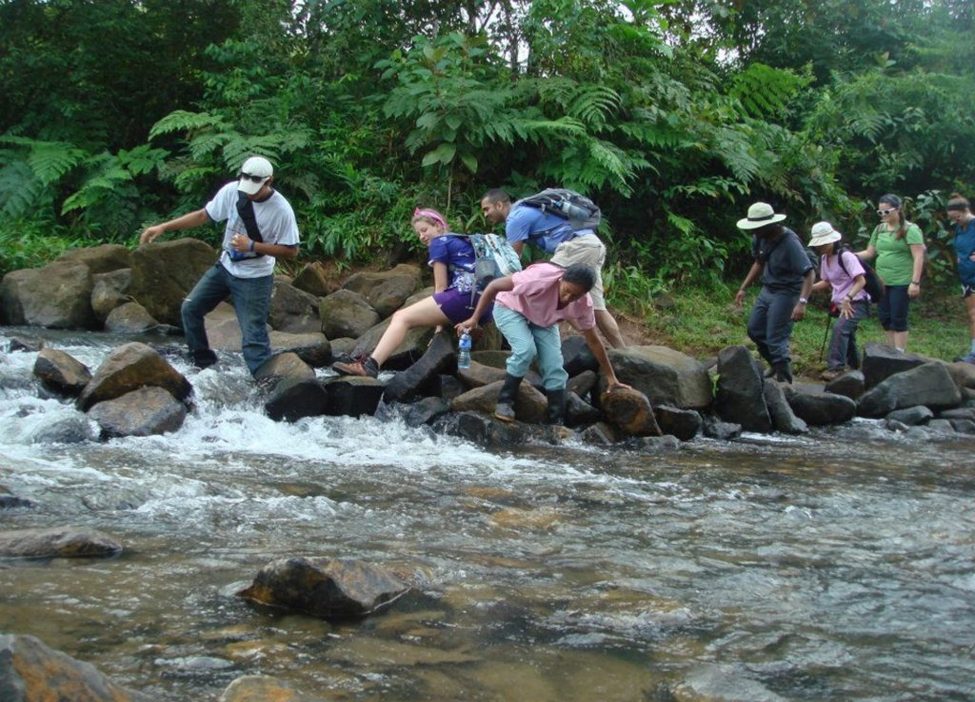
Two to four days on foot through dense tropical forest — river crossings, banana and cocoa groves, and a steady descent toward the village that's waiting on the other side.
Work shifts to whatever the community needs most: a field health clinic, a planting project, a classroom, a small construction job — set by local leaders, not by us.
Back out to refresh before the next push, with room for the Panama Canal, coffee plantations, volcanoes, or a zipline through the canopy.
Home to Panama's largest and most isolated indigenous population, deep in the mountains between Veraguas, Chiriquí, and Bocas del Toro. The nearest clinic is a three-hour walk; the nearest grocery store, four hours and a car ride away.
Home to the Cabécar, Costa Rica's largest and most isolated indigenous group. The nearest clinic is four hours out plus a drive; the nearest store means a four-hour hike straight up the mountain.
Every team's mission is set by local need, not by us — but it usually falls into one of six kinds of work.
Home visits, community health surveys, and a field clinic staffed by a licensed local provider — plus time set aside just to play with the kids.
Permaculture, aquaculture, and organic gardening built around what the village already grows and eats.
Teaching English, tutoring, and putting learning materials directly into local classrooms.
Reforestation and erosion control work suited to steep, remote mountain terrain.
Early planning for small-scale hydro, wind, or solar generation where the grid doesn't reach.
Painting, light construction, and clean-up projects requested by community leaders themselves.
Patients sign consent before any exam, and can refuse treatment at any point. No procedure is ever photographed.
Communities have given explicit consent for ISL teams to work with them — but individual photos, especially of children, still require asking.
Teams stay together from arrival to departure, accompanied by screened, bilingual ISL staff at all times.
Local offices in every country we serve track conditions continuously, guided by the U.S. State Department, WHO, CDC, and aviation safety authorities — and reroute the moment it's warranted.